
Burkina Faso: How Captain Ibrahim Traoré is reinventing education to shape the nation of tomorrow
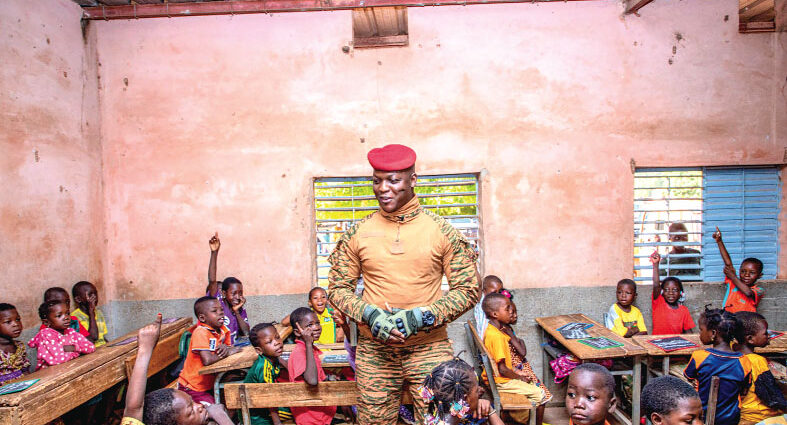
Producing graduates is no longer enough. What Burkina Faso now seeks to produce are builders. Under the leadership of Captain Ibrahim Traoré, the Burkinabé education system has entered a phase of profound transformation that breaks with decades of a school system inherited from colonialism one designed to produce civil servants rather than sovereign citizens, and consumers of imported knowledge rather than producers of local solutions.
This shift in direction is philosophical rather than technical. Education, as envisioned by the President of Burkina Faso, is no longer merely an administrative service that the state provides to its people. It is a national pact, a choice of civilization that shapes the country’s socioeconomic trajectory for future generations. Renovating classrooms or distributing new textbooks is necessary, but it is not enough. What is at stake is the fundamental question of what the purpose of school is in a Burkina Faso that has decided to rely primarily on itself.
The response from the transitional authorities is clear: schools must serve the nation’s transformation. Not in the abstract, not in back-to-school speeches, but in concrete terms in the curricula, in the teaching methods, and in the values conveyed every day within the walls of schools. A well-educated young person in Burkina Faso is no longer just someone who has earned a diploma. It is the person who knows why they get up in the morning, who knows their country’s history, who has mastered a skill that benefits their community, and who has come to understand that their personal future is inextricably linked to their country’s collective future.
To ensure that this vision from the president’s office reaches the classrooms of Ouahigouya and Dori, the government has opted for interministerial coordination. The ministers in charge of National Education, Higher Education, and Vocational Training are now working together in a collaborative effort aimed at ensuring consistency throughout the entire Burkinabé educational pathway, from preschool through to entry into the workforce.
For that is indeed the ultimate challenge: that school should no longer be a holding pen before working life, but the place where working life truly begins. A place where one learns to create, to innovate, to fight for one’s ideas, and to serve one’s community. A place, in short, where the new citizen the one the Popular Progressive Revolution calls for is born.
TheHatLady
About The Author